Catholic Massterclass: All About Holy Mass
For Catholics, Holy Mass is the supreme form of worship. This podcast seeks to explain the various aspects of the Mass in brief soundbites.
Listen on:








Episodes
14 hours ago
14 hours ago
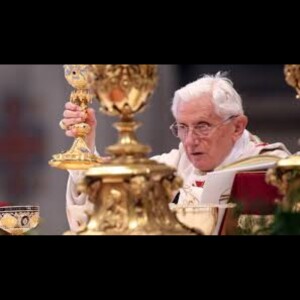
For this week’s Catholic Massterclass, we’re not going to move forward just yet. Instead, I want to focus on something that most people don’t notice during this part of the Mass. Even though it often goes unnoticed, it is a critical moment — not only for the priest, but for each member of the congregation. I hope it opens your eyes in a new way to your preparation for receiving Holy Communion.
Last week I spoke about the Lamb of God, the Fraction Rite, and the commingling of the Eucharistic Host and the Precious Blood of Christ. There is another part of that portion of the Mass that is easy to miss. While the Lamb of God is being sung, after the priest has commingled the Eucharistic species, he bows slightly and prays quietly until the Lamb of God has finished, or even a little after. What is he praying during that time? Is it worthwhile to know those prayers — and perhaps even to pray them yourself?
The Order of Mass in the Roman Missal provides two options for the priest:
(1) Lord Jesus Christ, Son of the Living God, who, by the will of the Father and the work of the Holy Spirit, through your Death gave life to the world, free me by this, your most holy Body and Blood, from all my sins and from every evil; keep me always faithful to your commandments, and never let me be parted from you.
or
(2) May the receiving of your Body and Blood, Lord Jesus Christ, not bring me to judgment and condemnation, but through your loving mercy be for me protection in mind and body and a healing remedy.
Up to this point in the Mass — and in what follows — the priest prays aloud on behalf of the people, standing in the Person of Christ. In this quiet moment, however, he prays personally. He bows before the Lord he is about to receive and recalls that he too is a man in need of mercy and protection. Scripture and Sacred Tradition remind us that religious leaders will be held to a higher standard, which makes these prayers especially important for the priest. He takes refuge in the power of the Death and Resurrection of Jesus, asking for fidelity, protection, and perseverance. Jesus says in the Gospel of John, “If you keep my commandments, you will abide in my love, just as I have kept my Father’s commandments and abide in his love” (Jn 15:10). The priest is asking for the grace to be faithful to the Lord’s commandments and, therefore, always remain with him.
There is another part to these prayers, however, that often goes unspoken. St. Paul writes to the Corinthians, “Whoever, therefore, eats the bread or drinks the cup of the Lord in an unworthy manner will be guilty of profaning the body and blood of the Lord. Let a man examine himself, and so eat of the bread and drink of the cup. For any one who eats and drinks without discerning the body eats and drinks judgment upon himself” (1 Corinthians 11:27-29). Receiving the Body and Blood of Christ is not casual. In this New Covenant sacrificial meal, we declare our allegiance to Christ. If we knowingly cling to grave sin, we contradict that allegiance. That is why St. Paul urges self-examination. The priest pauses here to examine his conscience and to beg the Lord’s mercy before approaching Holy Communion.
This seriousness, however, should not frighten us — it should steady us. The Eucharist is given as a remedy and a source of life. We simply must approach it honestly and reverently.
Monday Feb 23, 2026
Monday Feb 23, 2026
The next part of Holy Mass combines three different actions into one movement: the Fraction Rite, the Lamb of God (Agnus Dei), and the commingling of the Body and Blood of the Lord. Each of them reveals something distinct about what is taking place on the altar, but together they show one single mystery. Let’s take a closer look.
While the Lamb of God is sung or recited, the priest picks up the Eucharistic host and breaks it. From one portion he breaks a small fragment and places it into the chalice, praying quietly, “May this mingling of the Body and Blood of our Lord Jesus Christ bring eternal life to us who receive it.” All of this happens fairly quickly. (Yet another reason for the Sign of Peace to be sober and offered only to those nearest you — if we are busy chatting, we may miss one of the most revealing moments of the Mass.)
In Luke 24, the risen Jesus appears to two disciples on the Road to Emmaus. At table with them He took bread, blessed it, broke it, and gave it to them — and their eyes were opened. It was in “the breaking of the bread” that they recognized Him. The Church deliberately repeats this action at every Mass. The breaking is not practical preparation; it is proclamation. A living body is not divided — a sacrificed one is. The fraction shows sacramentally what the consecration has made present: the sacrifice of Christ. From the earliest days of Christianity, the Eucharistic worship was even called “the Breaking of the Bread.” We recognize Christ precisely at the moment His sacrifice is shown to us.
As the Host is broken, we sing: Lamb of God, you take away the sins of the world, have mercy on us…grant us peace. Throughout the Old Testament, lambs played a central role in worship. The Passover lamb protected Israel from death and had to be eaten. The sacrifices offered in the Temple brought a kind of reconciliation with God, especially on the Day of Atonement. When John the Baptist called Jesus the Lamb of God who takes away the sins of the world, he revealed that all those sacrifices pointed to Him. So while the priest performs the action of sacrifice, the congregation speaks its meaning. We are not watching a ritual; we are witnessing the sacrifice of Christ. Notice the pattern of the prayer: We ask for mercy; we ask again for mercy; finally we ask for peace. Peace is not a substitute for mercy — it is the result of mercy. Before receiving the Lamb who judges the living and the dead, we persistently beg forgiveness, and only afterward do we ask for the peace that comes from reconciliation with God.
After breaking the Host, the priest places a fragment into the chalice. In death, Christ’s Body and Blood were separated. In the Resurrection, they are united forever. The commingling does not make Christ alive — He is always the living Lord in the Eucharist — but it shows sacramentally that the sacrifice made present on the altar is the sacrifice of the risen Christ. The One offered to the Father is not dead, but living. The priest prays quietly that this mingling bring eternal life to those who receive it. The Eucharist is life-giving, but it must be received properly. This prepares us for the next moment of Mass when we will acknowledge our unworthiness before Communion.
So in just a few moments the Church shows us a very large window into the mystery of Jesus: He is sacrificed (the breaking); He is identified (the Lamb of God); He lives forever (the mingling).
Monday Feb 16, 2026
Monday Feb 16, 2026
Following the Lord’s Prayer during Mass comes the Sign of Peace or the Rite of Peace. There are two places where instructions are given in the Roman Missal, once right in the Order of Mass and, before that, in the General Instruction of the Roman Missal, paragraph 82. It’s probably better to start with the paragraph from the GIRM.
Paragraph 82 mentions three things about the Sign of Peace: first, it is to be understood as a preparation for Holy Communion, a time for the faithful people in the pews to express to each other that we share an ecclesial communion (we are united - hopefully we are united - in our love for the Church and Her doctrine) and mutual charity toward one another; second, that the sign of peace to be given is established by the local conference of bishops and by local customs and cultures (in other words, what does the Sign of Peace actually look like in real time?); third, that the sign of peace is to be given in a sober manner and only to those nearest to each person. These are all very interesting points that could be expanded upon for pages, especially the third point, but we will leave it as a simple explanation for what we’re looking for at this point in Holy Mass. Before we get to that explanation, let’s take a look at the Order of Mass.
When you pay close attention to the priest during this part of Mass, you’ll notice that he is no longer speaking to the Father, as he does almost the entire Mass, but to Jesus the Son. “Lord Jesus Christ, you said to your apostles…” Some priests signify this shift in the Divine Subject by looking directly at the Eucharist, the living Body and Blood of the Lord. The priest acknowledges that it is Jesus who gives us His peace, which is supreme over any other type of peace that can be found. His peace is supernatural, while any other peace is merely natural. It’s this supernatural peace that we’re seeking. Jesus gave that peace in a number of places, but the specific reference here comes from John 14:27, which comes at the Last Supper. We can see that Jesus gave us the supreme gift of the Eucharist at the Last Supper, but he also gave us His peace, which is also an extraordinary gift to receive! When the priest has finished his prayer to Jesus, notice what he says to the congregation: “May the peace of the Lord be with you always.” Father is not offering you his natural peace, but the supernatural peace of Christ. And when he instructs those present to offer each other the sign of peace, it is the peace of Christ that we are supposed to be offering to those around us. Maybe this can help us see why it ought to be a sober moment rather than a chaotic one. Maybe this can also help us to see why this moment is not one for us to catch up with each other or comment to each other about the homily, but instead to focus exclusively on desiring the peace that surpasses all understanding to rest upon each person’s heart and mind. What a profound desire to share with each other!
The reason for offering the Sign of Peace during Mass comes from the Bible and history. Jesus gives instructions to his disciples during the Sermon on the Mount that we are to make peace with our brethren, to reconcile with them if possible, before offering our sacrifice on the altar. The Sign of Peace can act as a sign (or could be an acknowledgement) of such reconciliation. St. Paul also instructs the Christians in both Corinth and Rome to give each other a holy kiss of peace (Romans 16:16, 1 Cor 16:20). Historically speaking, we can look back to our old friend St. Justin Martyr, who wrote about the worship of 2nd century Christians while he was living in that time. He mentioned that the people would greet one another with a kiss [of peace]. Over time, the Sign of Peace has been “located” in different times of the Mass and has had different appearances, but it has always been included at least as an option. Even today, it’s not a strict requirement to include the large-scale sign of peace, but the priest at least has to offer the peace of Christ to the congregation with the proper response.
Monday Feb 09, 2026
Monday Feb 09, 2026
There is much more that could be said about the Eucharistic Prayers in the Roman Missal and in general, but we’ll move on to the next part of Holy Mass, which is the Lord’s Prayer. There are a few interesting points to make about the Lord’s Prayer and the surrounding text, including a surprise statement that many believe to have Protestant origins but really comes from the prayers of the early Church.
The introduction to the Lord’s Prayer during Mass states: “At the Savior’s command and formed by divine teaching, we dare to say…” The Lord’s Prayer (often called the Our Father) is the only prayer specifically commanded by Jesus in the Gospels. It is found in two places: Matthew 6:9-13 and Luke 11:1-4. In Luke’s version, Jesus finished praying and his disciples requested that he teach them how to pray. He then instructed them to pray this prayer, which is why we call it the “Lord’s Prayer” and why we place such an emphasis on praying it daily. In the early Church, it was an expectation that each Christian would pray the Lord’s Prayer on a daily basis. Then in Mass we run into the strange line, “...we dare to say…” What does that mean? Why do we dare to say the Lord’s Prayer if Jesus instructed us to pray it? Again, the early Church Fathers repeatedly called it a daring and bold prayer, acknowledging that it is a prayer of sonship. We are only children of God because of our baptism, but that acknowledgement also implies that we are on a level of relationship to God that Jesus is on. We are acknowledging that baptism causes us to participate so fully in the life of Christ that we share in his divine nature. I don’t know what you think about that, but I certainly see that it is a bold statement! We are unworthy sinners and yet Jesus causes us to be raised to his level of relationship with God. Incredible!
Of course, the heart of this part of Mass is the Lord’s Prayer itself. We could speak for hours about each line of the Prayer, but I will give here just a brief note that there are seven petitions in the Lord’s Prayer. The first three are focused solely on God being glorified and the final four are focused on our need for God’s grace. This is a good preparation for Holy Communion: acknowledge God’s supreme goodness, desire that all would know Him as He ought to be known, and then ask Him for what only He can provide.
The final part of the prayer includes a brief prayer called the Embolism (a little stoppage in the communal prayer for the prayer of the priest) followed by the famous doxology that many people associate with the Protestant community because they insert it at the end of the Lord’s Prayer each time they pray it (while Catholics only say it during Mass). This is longer than we have space for, but there is a document called the Didache, which included the teaching of the Apostles from the earliest days of the Church. In the Didache is found an instruction to insert the line, “For to you is the power and the glory forever.” It became so familiar to the Christian community that most copyists of the Gospels wrote it into the Gospel. When the Scriptures began to be translated into other languages, especially into the King James Version, they assumed the line had always been in the Gospels. Interestingly enough, the Protestants who love the Bible have a line in their biblical prayer that comes from Catholic Tradition.
Monday Feb 02, 2026
Monday Feb 02, 2026
The final of the primary Eucharistic Prayers, Eucharistic Prayer IV (EPIV) is easily the least used of them all. In fact, I wouldn’t be surprised if none of you had ever been at a Mass when EPIV was used. It’s a little strange to me why it isn’t used often, but it could be that it sounds a little different from the others and is a bit on the longer end of the spectrum. Here are some unique features of it:
Eucharistic Prayer IV has its own Preface, which must be used whenever EPIV is used. The reason for this is that the Preface and the first half of the Prayer give a beautiful summary of Salvation History, so any other Preface wouldn’t quite fit with the Prayer. Because of this, Eucharistic Prayer IV cannot be used on days with a proper Preface, which includes many Sundays and most solemnities. This teaches us that the Eucharistic Prayer is not a collection of interchangeable parts, but a unified act of worship with its own internal logic.
The Preface praises God who has always existed before all ages and has dwelt in unapproachable light. The angels surround his heavenly throne gazing upon the glory of his face day and night. From that reality, he created everything in wisdom and in love, culminating in the creation of man and woman in his own image. We lost his friendship through disobedience, but he came to our aid by way of covenants and the teaching of the prophets. Finally, he “so loved the world that in the fullness of time,” he sent his Only Begotten Son to be our Savior. He proclaimed the good news of salvation, gave himself up to death, and rose from the dead, destroying Death itself and restoring life to our fallen race. Finally, he sent the Holy Spirit bringing his work to perfection in the world so he might sanctify creation to the full. All of that is found in the first half of Eucharistic Prayer IV - so lovely!
You can tell from that summary and from looking at the full Prayer that EPIV is very Trinitarian in its composition and contains several references to the Gospel of John. There are several lines that could be found in that Gospel, which also sounds different from the other three Gospels. There is a more poetic sound and feel to this Eucharistic Prayer, while at the same time clearly maintaining the reality of the sacrificial nature of the Mass.
Just like Eucharistic Prayers II and III, Eucharistic Prayer IV has its origins in the worship of the early Church. If you look up “Anaphora of St. Basil” (Anaphora means Eucharistic Prayer) online, you’ll find that it is remarkably similar to Eucharistic Prayer IV. The Anaphora of St. Basil has its origins in the 4th century in Alexandria in Egypt. Some people argue that it is one of the earliest Eucharistic Prayers we have in writing. Drawing heavily from the Anaphora of St. Basil, the Church composed Eucharistic Prayer IV in the 20th century, preserving its theological structure and spirit. It has influenced the Greek Eucharistic Prayers of St. John Chrysostom and St. James, and still influences some of our Eastern Catholic brethren of the different Catholic rites, as well as some who are no longer in full communion with Rome.
There we have it. One Eucharistic Prayer (The Roman Canon) that is very closely tied to the Eucharistic Prayer of the Traditional Latin Mass and three Eucharistic Prayers that are very closely tied to Eucharistic Prayers from the early Church. What a gift!
Monday Jan 26, 2026
Monday Jan 26, 2026
For many priests and laypeople alike, Eucharistic Prayer III settles as a nice middle ground between the Roman Canon and Eucharistic Prayer II. The General Instruction of the Roman Missal (GIRM) suggests that Eucharistic Prayer III is most appropriately used on Sundays and Holy Days of Obligation and many priests follow that suggestion. Here are some unique features of this Eucharistic Prayer:
The very first paragraph after the Sanctus states that the Lord “never cease[s] to gather a people to yourself, so that from the rising of the sun to its setting a pure sacrifice may be offered to your name.” The acknowledgement that it is the Lord’s initiative to gather people to himself is an important one. No matter how persuasive you or I may be, it is the Lord who must act if a person is going to be drawn to him. Jesus says, “No one can come to me unless the Father who sent me draws him” (John 6:44). What’s the purpose of being drawn to the Lord? People of all nations are gathered to God for the purpose of offering a pure sacrifice to his name. This is a direct connection to a passage from the Book of Malachi in the Old Testament. As the Lord scolds the Temple priests, he says, “For from the rising of the sun to its setting my name is great among the nations, and in every place incense is offered to my name, and a pure offering; for my name is great among the nations, says the Lord of hosts” (Malachi 1:11). This is significant: the Lord is prophesying that a day will come when people from “the nations” will offer sacrifice to his name. It’s not just any sacrifice, but the minchah sacrifice, which was a grain offering. Normally the sacrifices could only be offered in the Temple, but here the Lord is suggesting that the sacrifices will be offered around the world. It sure sounds like the Mass, an offering of the Bread of Life around the world, is the fulfillment of this passage!
As you can tell, Eucharistic Prayer III heavily emphasizes the sacrificial nature of the Mass. There are several instances of mentioning the nature of our worship with several mentions of the sacrifice or the One being offered as we participate in the Sacrifice of Jesus at Calvary for the forgiveness of sins.
One more point about the Prayer itself: EPIII is the only Eucharistic Prayer that allows the priest to insert the specific name of the Saint of the day or the Patron Saint of the place where Mass is being offered. EPI includes those two lists of saints and EPs II and IV have the basic listing of Mary, Joseph, the Apostles, and all the Saints, but EPIII adds the general category of Martyrs and offers as an option the particular Saint of the day or place. Unfortunately, some priests like to insert the specific Saint of the day into EPII, but they should not do so. That is part of what makes EPIII unique.
Eucharistic Prayer III is uniquely crafted from a combination of historical Eucharistic Prayers from history. The beautiful prayers were taken from a wide range of ancient Eucharistic Prayers: Mozarabic Liturgy, Anaphora of Theodore of Mopsuestia, Anaphora of St. Basil, Anaphora of St. Clement, and the Leonine Sacramentary. My point in bringing this up is to connect with history - these names listed here go back several centuries into the early days of the Church. Like with Eucharistic Prayer II, the Church is endorsing a return to historical worship as a way to join the Heavenly worship of the Mass.
Monday Jan 19, 2026
Monday Jan 19, 2026
Last week we looked at the longest Eucharistic Prayer (The Roman Canon) and this week we will look at the shortest Eucharistic Prayer (Eucharistic Prayer II). As I have mentioned the past couple of sessions of our Catholic Massterclass, there is controversy over the reality of options for the Eucharistic Prayer. Nonetheless, we have a variety and each of them has unique characteristics and often rich imagery in the prayers. Here are some unique characteristics of Eucharistic Prayer II (EPII):
The first unique feature of Eucharistic Prayer II is that it includes its own proper Preface, though it may also be used with other Prefaces from the Roman Missal. It is Trinitarian in its emphasis and has strong connections with a very early version of the Eucharistic Prayer used during Mass in the early Church.
As I mentioned, EPII is the briefest of all of the Eucharistic Prayers and appears best suited for weekday Masses, although it can also be used on Sundays and Holy Days. One of the reasons for this is the mention of the dewfall during the epiclesis: “Make holy…these gifts…by sending down your Spirit upon them like the dewfall…” This is a strong reference to the miraculous bread from Heaven that came to the people in the desert by way of the morning dew bringing the manna on the ground each morning. Those who attend Mass during the week are coming to receive their daily miraculous Bread from Heaven.
One more unique characteristic of EPII that I will mention comes toward the end of the Prayer and sounds a little awkward: “Remember also our brothers and sisters who have fallen asleep in the hope of the resurrection, and all who have died in your mercy: welcome them into the light of your face.” Where does that line come from? What does that mean? There are several references in the Old Testament, especially in the Psalms, that refer to God shining the light of His face upon those He wishes to care for and save. When we pray that the dead be welcomed into ‘the light of God’s face,’ we are asking that they be brought into God’s saving presence—what Scripture describes as seeing God face to face, which is Heaven itself. Beautiful!
A very neat fact about Eucharistic Prayer II is that the entire prayer has connections with the worship of the early Church. St. Hippolytus lived during the 3rd century - 1800 years ago - and he wrote out the prayer used during the consecration of the Holy Eucharist when people gathered for worship, and it is remarkably similar to Eucharistic Prayer II. While scholars debate details of its exact authorship and use, the Church sees in it a trustworthy witness to very early Eucharistic prayer. You could search online for “Eucharistic Prayer from St. Hippolytus” to see what I mean. Though the prayer fell out of use over time, the Church has endorsed a return to it as we worship God and seek his daily miraculous Bread from Heaven.
Monday Jan 12, 2026
Monday Jan 12, 2026
We’ll spend the next four weeks looking at each of the primary Eucharistic Prayers provided by the Church in the Roman Missal. The first one - Eucharistic Prayer I or the Roman Canon - is the longest and most connected to history. Many of us are aware that the look and sound of Mass was changed in the 1960s, going from Latin to the vernacular language of any given place. In the Traditional Latin Mass (TLM), there was one Eucharistic Prayer that was prayed at each and every Mass. If you were to translate that one Eucharistic Prayer into English, you would end up with something very similar to Eucharistic Prayer I. It’s not an exact match, but it’s very close. Because of that, we can be confident in saying that the Roman Canon is a prayer that has been present at Mass for centuries and has provided the structure of the Eucharistic Sacrifice for countless saints, missionaries, martyrs, and faithful people of God.
There are some unique features of the Roman Canon that make it stand out compared to the other three.
There are two long lists of saints included in the Roman Canon, including all of the Apostles, a few of the earliest popes, and other men and women from the early Church. Here we are reminded of those who have laid a firm foundation of faith for us and who still cheer us on as we strive to enter through the narrow door. These members of the Church Triumphant become present to us, the Church Militant, in the Heavenly worship of Holy Mass.
There are several mentions of sacrificial images, including some from the Bible. The sacrifice of Abel, whose offering of his first fruits was pleasing to God, the sacrifice of Abraham, willing to offer his only son Isaac as a sacrifice (though, of course, we know the Lord prevented him from actually carrying out the sacrifice), and the offering of bread and wine by Melchizedek provide the perfect foreshadowing of the Sacrifice of Jesus on the Cross and in the Eucharist, the firstborn and only beloved Son of the Father offered for our salvation, made present here in the form of bread and wine. The words of the Roman Canon remind us that the Eucharistic Sacrifice—Christ’s one saving sacrifice made present—is the necessary and pleasing offering through which God applies the grace that saves us from eternal damnation. The Roman Canon is not concerned with explaining the Mass to us; it is concerned with offering the sacrifice to God.
Another unique feature comes in the wording leading up to the Words of Consecration. The priest says and enacts what Jesus did at the Last Supper. Jesus “raised his eyes to Heaven” and the priest is instructed to look upward. Jesus “took this precious chalice in his holy and venerable hands” and the priest is instructed to pick up the chalice. It’s interesting it says, “this precious chalice,” reminding us that there is a mystical reality at work that we can’t see, as though the chalice the priest is using is drawn into and participates in the mystery of the very chalice used by Christ at the Last Supper.
There are more unique features to mention, but the last one I’ll mention here are the two moments when the priest pauses his prayers to silently pray for the living and the dead, reminding us all that we are there to offer the Mass for those present, but also for those who are not present at the Sacrifice. We pray that, somehow, God may receive the Sacrifice of the Mass and supply grace for those who are not yet convicted by faith to be present and for those who have passed before us and need our prayers to assist them into Heaven. So, always come to Mass with some prayer intention(s) and hold them in mind during the Eucharistic Prayer.
The Roman Canon is a beautiful Eucharistic Prayer! Unfortunately, because of all of these unique features, it is much longer than the others and the length often deters priests from using it. Many people have expectations of a brief, efficient Mass. In the case of this parish cluster, our Mass schedule is pretty tight, so time is a prized commodity. What’s more, the current pastor can’t figure out how to preach shorter homilies. 🙂 Maybe we can switch out our expectations (and maybe the pastor can learn to preach shorter homilies), so we can fully embrace and even grow to love the longer Eucharistic Prayer.
Next week, we’ll look at Eucharistic Prayer II, the shortest of them all.
Monday Jan 05, 2026
Monday Jan 05, 2026
After the Holy, Holy, Holy (the Sanctus), the Mass enters its most sacred moment: the Eucharistic Prayer. Everything we have done so far has been leading to this prayer, and everything that follows flows from it. This is the prayer in which Christ’s sacrifice on the Cross is made present to us sacramentally. Although there are several Eucharistic Prayers, they all share the same essential structure. Understanding these common parts helps us recognize that we are participating in one great act of worship, not a series of separate prayers.
The Eucharistic Prayer is always directed to God the Father.
The priest does not pray to the congregation or about God, but on behalf of the Church, to the Father, through Jesus Christ, in the power of the Holy Spirit. This prayer reveals the deeply Trinitarian nature of the Mass.
The Eucharistic Prayer begins by continuing the spirit of the Preface and the Sanctus: giving thanks to God for His saving works.
The word Eucharist itself means thanksgiving. Before anything is offered, the Church first acknowledges who God is and what He has done.
In every Eucharistic Prayer, the priest invokes the Holy Spirit upon the bread and wine. This is called the epiclesis.
Just as the Spirit hovered over the waters at creation and overshadowed Mary at the Annunciation, the Spirit now descends to bring about God’s saving action. The transformation of the gifts is not magic—it is the work of God.
The priest then recounts the words and actions of Jesus at the Last Supper.
These are not merely remembered or reenacted. When the priest speaks Christ’s words, Christ Himself acts through the priest. The bread and wine truly become the Body and Blood of Jesus, making present the one sacrifice of Calvary.
After the consecration, the Church proclaims the Mystery of Faith.
In Scripture, “remembering” does not mean recalling something from the past. It means making it present. The Church now stands mystically at the Cross, the Tomb, and the Resurrection, united to Christ’s saving work.
The Church then offers to the Father: Christ Himself, the Sacrifice He has entrusted to the Church, and Herself, united to Him. We do not offer a new sacrifice, but participate in Christ’s one eternal offering. Our prayers, sufferings, and lives are drawn into His perfect gift to the Father.
The Eucharistic Prayer always includes prayers for the Church on earth, for the living and the dead, offered in union with the Saints in Heaven. This shows that the Mass is never private or individual. It is cosmic in scope, uniting heaven and earth, the living and the dead, into one act of worship.
We conclude with the Doxology: “Through Him and with Him and in Him…” All glory is given to the Father, through Christ, in the Holy Spirit.
The people respond with the Great Amen, affirming and embracing everything that has just taken place. This is not a routine response—it is the people’s solemn assent to the sacrifice offered in their name.
Monday Dec 29, 2025
Monday Dec 29, 2025
The Holy, Holy, Holy—the Sanctus—comes directly from Sacred Scripture. In Isaiah 6, the prophet hears the seraphim crying out “Holy, holy, holy is the LORD of hosts,” and in Revelation the same hymn resounds in the worship of heaven. This is the song of heaven itself. When we sing it at Mass, we are not merely recalling a biblical moment—we are entering into heavenly worship. The liturgy lifts us beyond time and space and unites us to what is always happening before the throne of God.
Immediately after this hymn, we kneel. That posture is not accidental. In the Gospels, kneeling is one of the most common responses when people come to recognize the divinity of Jesus—whether in awe, supplication, or worship. We kneel because something infinitely greater than a symbol is about to take place. The same Jesus who is worshiped in heaven is about to become sacramentally present on the altar. Our bodies confess what our voices have just proclaimed: God is here.
By the fourth century, Christians in both East and West were already singing the Holy, Holy, Holy during the Eucharistic Prayer—clear evidence that the Church from her earliest centuries understood the Mass as a participation in the worship of heaven. To call God the “Lord of hosts” is to confess that the Mass is never a private gathering. Every time we worship, we stand before the God who commands the armies of heaven—and they worship with us.